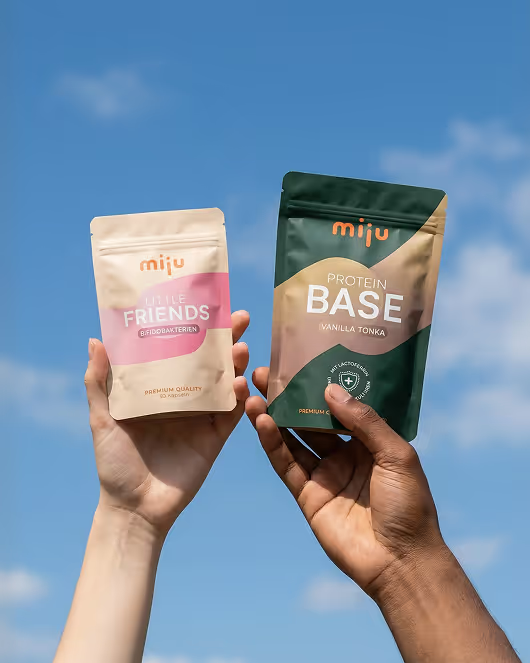
The Most Important Components of Human Milk: What Life Begins With

Human milk is far more than just nutrition. It contains specific components that work together and support us from the very beginning of life. At miju, we call this interplay the Primal Substances Principle. In this article, you'll learn why these particular substances stand at the center of our approach and why they form its foundation.


The Primal Substances Principle: Why nature provides certain substances together, and what that means for your health today
At the beginning of your life, as a baby, you received something that has become increasingly rare in modern life. Through human milk, your mother provided you with a small group of remarkable substances. They helped build your gut microbiome, train your immune system, and shape your metabolism, precisely during the period when all of these systems were still developing.
These substances do not disappear simply because you grow up. Many of them are needed throughout life. Yet in everyday life, we hardly get them anymore. That's exactly where we come in.
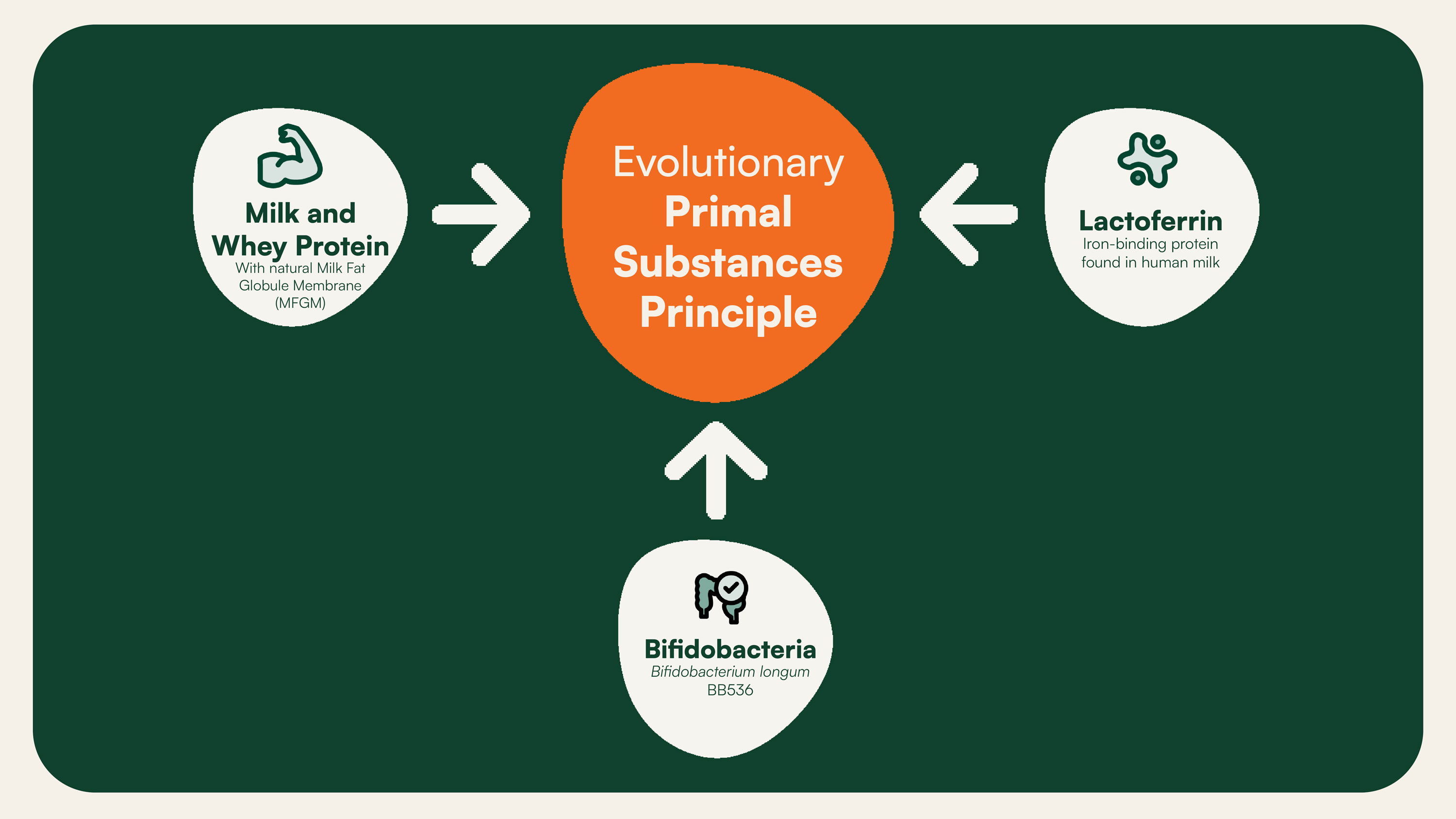
Three of these substances are at the heart of miju: lactoferrin, bifidobacteria, and native milk and whey protein. The native protein naturally contains the milk fat globule membrane, or MFGM, which plays an important role in the nervous system. Together, they belong to the unique components of human milk that support the beginning of human life.
The Composition of Human Milk: The Most Important Components for Babies
Human milk is far more than nourishment for babies. This becomes especially clear in colostrum, the first milk produced after birth. Often referred to as a natural first protection, it provides newborns with a high concentration of important protective factors and supports digestion and gut maturation during a phase in which the microbiome and many essential bodily functions are still developing.
Alongside fat, carbohydrates, and protein, human milk contains a wide range of bioactive substances that help protect and shape infants [1,2]. They do not simply provide energy. They provide information to the body.
Human milk is not a static system. Its composition changes throughout lactation and can even adapt daily to the needs of the baby. What is particularly remarkable is that certain substances repeatedly appear together despite these changes.
During the first weeks of life, much is decided. Which bacteria colonize the gut, how the immune system learns what is normal, and how the intestinal barrier develops. In this phase, the components of human milk act almost like instructions [3,4]. They help the right microbial residents establish themselves while keeping others in check.
The beauty of it is that nature does not leave this to chance. These substances occur together in human milk, in a specific composition, because they function best together.
The Composition of Human Milk: Lactoferrin, Bifidobacteria, Milk and Whey Protein
We call it the Primal Substances Principle, and it is at the core of everything we do.
The idea is simple. Through human milk, nature does not provide newborns with just any mixture. It provides these particular substances, in a specific balance, because they belong together.
This principle has evolved over millions of years. Bifidobacteria, for example, have accompanied humans for a very long time. They have adapted so closely to us that scientists speak of human-residential strains that are truly at home in the human gut [5]. Relationships like these do not develop overnight. They are the result of a long shared history.
That is why we do not treat these substances as ordinary ingredients. We see them for what they are: part of the biological foundation with which life begins.
Primal substances from human milk belong together
Lactoferrin, bifidobacteria, milk and whey protein form the foundation of our Primal Substances Principle.
Why our Protein Base was created
The composition of human milk is anything but random. Nature combines specific ingredients because they complement and support one another. Likewise, nothing in our formulations is left to chance. Every ingredient in our Protein Base was carefully selected and fulfills a specific role within the Primal Substances Principle.
The name Protein Base is intentional. To us, native milk and whey protein, lactoferrin, and bifidobacteria form a foundational basis of nutrition that accompanies humans from the very beginning of life. That is why our Protein Base brings together the very ingredients that stand at the center of our Primal Substances Principle in a single formulation inspired by this natural composition.
This is not about replicating human milk. It is about applying the idea behind it: certain ingredients naturally occur together from the very start and function as an integrated system. The Primal Substances Principle is our way of translating that idea into modern nutrition.
Why Lactoferrin, Bifidobacteria, Milk and Whey Protein work together
The key is not the individual ingredient, but the interaction between them.
Each component has been extensively studied on its own. Yet it is only in the right combination that the larger picture emerges. At miju, we bring these substances together, not as a random blend, but as a carefully designed system.
What makes it particularly fascinating is how they support one another. It is a genuine symbiosis. Lactoferrin promotes the growth of bifidobacteria and helps them establish themselves [14]. In return, bifidobacteria produce compounds such as acetate, which strengthens the gut and creates an environment in which the system can thrive [15]. Native milk and whey protein provides the building blocks needed for cells, structure, and tissue development. Each contributes to the effectiveness of the others.
What does this mean for you? Instead of isolated ingredients, you get a coordinated system. Together, these three substances offer more than any one of them could alone.
The Role of Lactoferrin, Bifidobacteria, and MFGM throughout Life
At the beginning of life, your immune system is not yet fully developed. It encounters the world for the first time and must learn what is harmless and what is not. The components of human milk help guide that process. They support a system that is still highly vulnerable to the unfamiliar and help shape its future development [10,11].
Here is the part that is often overlooked. Modern life places us in a surprisingly similar situation. We are constantly exposed to things our bodies were never designed to encounter: new food ingredients, environmental toxins, chronic stress, unfamiliar microbes, and new risk factors. Once again, the immune system faces an enormous amount of uncertainty.
Why Bifidobacteria and other Components of Human Milk decline over Time
There is another important factor. Some of our oldest companions become less abundant over time. In industrialized societies, microbial diversity is shrinking [12], and bifidobacteria, which dominate the infant gut, decline significantly throughout life [6]. We gradually lose many of the same allies that once helped us navigate the unknown [13].
Why the Components of Human Milk may remain relevant later in Life
That is why we do not see these substances merely as a starting aid. There is good reason to believe they represent something like an evolutionary response to many modern challenges. Not only during early development, but also for maintaining health across the lifespan. The same companions that helped you face countless new experiences as a baby may still contribute to balance later in life.
One clue comes from the oldest among us. When researchers examine people who retain particularly high levels of bifidobacteria in old age, they often find the individuals who live the longest. Centenarians have been shown to possess higher levels than younger elderly populations [7]. This does not prove a single mechanism, but it fits remarkably well with the broader picture.
The Primal Substances Principle aims to reverse that loss. It restores substances that were once naturally present at the beginning of life but tend to disappear from the modern diet and lifestyle. In a form your body has known all along.
Lactoferrin, Bifidobacteria, Milk and Whey Protein: The Three Substances at a Glance
To make things more concrete, here are the three building blocks in summary:
Lactoferrin - The Immune Protein
Lactoferrin is a multifunctional protective protein found in milk. It performs a wide range of functions in the body. For example, it binds iron and forms part of the body's natural defense system. It is also present in human milk and is among the first protective factors a baby receives.
Bifidobacteria - Supporting a balanced Gut Microbiome
Bifidobacteria are beneficial residents of the gut. Our strain, Bifidobacterium longum BB536, is one of the most extensively studied probiotic strains available [8]. It is human-residential and remains present throughout life, unlike many bacteria associated primarily with infancy.
Native Milk and Whey Protein with MFGM (Milk Fat Globule Membrane)
Our protein is native, meaning its natural structure remains intact. Because it is minimally processed and non-denatured, its original structure is preserved. Through our gentle manufacturing process, the milk fat globule membrane (MFGM) also remains present. MFGM contains components that are important for the development of nerve cells as well as structural tissues throughout the body. Research has linked MFGM to cognitive development and the formation of neural pathways [9].
What the Primal Substances Principle means for your Nutrition and how we put it into Practice
miju brings back the substances with which life begins and that help shape our earliest development. In a combination inspired by the natural composition of human milk. That is the Primal Substances Principle.
Rather than focusing on isolated ingredients, we focus on how they work together.
To us, lactoferrin, bifidobacteria, and native milk and whey protein are not just ingredients. They form the foundation of our product philosophy and therefore sit at the heart of our Protein Base.
If you would like to learn more about these individual components, you can find additional information on our product pages and throughout our knowledge hub covering native milk protein, lactoferrin, and bifidobacteria.
Literature
1. Ballard, O., Morrow, A. L. (2013): Human Milk Composition: Nutrients and Bioactive Factors. Pediatric Clinics of North America 60(1), 49–74.
2. Lönnerdal, B. (2016): Bioactive proteins in human milk: health, nutrition, and implications for infant formulas. The Journal of Pediatrics 173S, S4–S9.
3. Milani, C. et al. (2017): The First Microbial Colonizers of the Human Gut: Composition, Activities, and Health Implications of the Infant Gut Microbiota. Microbiology and Molecular Biology Reviews 81(4), e00036-17.
4. Gopalakrishna, K. P., Hand, T. W. (2020): Influence of Maternal Milk on the Neonatal Intestinal Microbiome. Nutrients 12(3), 823.
5. Wong, C. B., Odamaki, T., Xiao, J. Z. (2020): Insights into the reason of Human-Residential Bifidobacteria being the natural inhabitants of the human gut and their potential health-promoting benefits. FEMS Microbiology Reviews 44(3), 369–385.
6. Odamaki, T. et al. (2016): Age-related changes in gut microbiota composition from newborn to centenarian. BMC Microbiology 16, 90.
7. Biagi, E. et al. (2016): Gut Microbiota and Extreme Longevity. Current Biology 26(11), 1480–1485.
8. Wong, C. B., Odamaki, T., Xiao, J. Z. (2019): Beneficial Effects of Bifidobacterium longum subsp. longum BB536 on Human Health. Journal of Functional Foods 54, 506–519.
9. Thongseiratch, T. et al. (2024): Bovine Milk Fat Globule Membrane Supplementation and Neurocognitive Development: A Systematic Review and Meta-Analysis. Nutrients 16(14), 2374.
10. Gensollen, T., Iyer, S. S., Kasper, D. L., Blumberg, R. S. (2016): How colonization by microbiota in early life shapes the immune system. Science 352(6285), 539–544.
11. Belkaid, Y., Hand, T. W. (2014): Role of the Microbiota in Immunity and Inflammation. Cell 157(1), 121–141.
12. Sonnenburg, E. D., Sonnenburg, J. L. (2019): The ancestral and industrialized gut microbiota and implications for human health. Nature Reviews Microbiology 17(6), 383–390.
13. Blaser, M. J. (2017): The theory of disappearing microbiota and the epidemics of chronic diseases. Nature Reviews Immunology 17(8), 461–463.
14. Oda, H. et al. (2013): Isolation of a Bifidogenic Peptide from the Pepsin Hydrolysate of Bovine Lactoferrin. Applied and Environmental Microbiology 79(6), 1843–1849.
15. Fukuda, S. et al. (2011): Bifidobacteria can protect from enteropathogenic infection through production of acetate. Nature 469(7331), 543–547.